Written by: Emad Azimi / Translated by Ebad Azimi
In recent weeks, Iran has experienced one of the most severe periods of economic pressure in recent decades. The intensification of economic sanctions has placed unprecedented strain not only on the state but, more critically, on Iranian society itself. What initially manifested as limited economic discontent rapidly escalated into widespread social protests. These demonstrations first compelled merchants and shopkeepers to close their businesses and gradually expanded into the streets, drawing in diverse social groups.
According to available reports, the protests began in Tehran and, within days, spread to numerous cities across the country. What distinguishes this wave of unrest from previous episodes is not merely its geographic scope, but the nature of the protesters’ demands and slogans. Alongside objections to deteriorating living conditions, there is a profound anger directed at the domestic and foreign policies of the Islamic Republic—an anger rooted in years of systemic inefficiency, political repression, and costly regional adventurism.
This domestic unrest cannot be analyzed in isolation from Iran’s declining regional position. Following the collapse of Bashar al-Assad’s government in Syria and the disruption or weakening of Iran’s proxy networks, Tehran has faced increasing isolation within regional power dynamics. The failure of prior negotiations between Iran and the United States, followed by a brief yet destructive military confrontation that severely damaged Iran’s military infrastructure and nuclear facilities, has further accelerated this erosion and exposed the fragility of the existing power structure.
However, the central issue extends beyond the crisis of the Islamic Republic itself. The more fundamental question concerns the nature of the political order that may emerge should the current regime collapse or suffer a significant weakening.
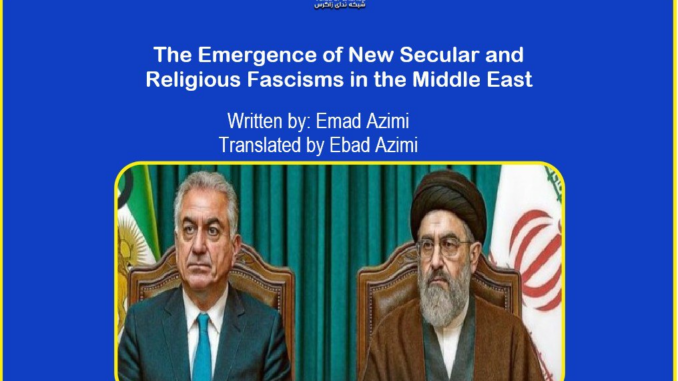
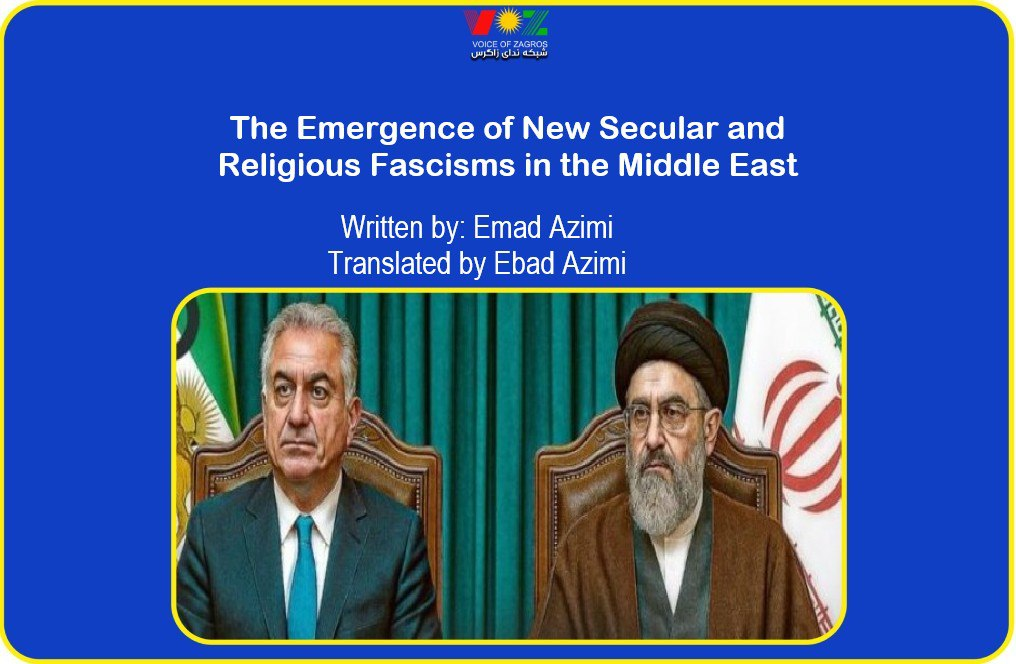
Within this context, a deep and troubling rift has emerged among Iran’s opposition forces—a division that ultimately benefits none of the country’s political or social actors. Certain factions, by exaggerating their historical or symbolic significance, seek to predetermine Iran’s political future. Attempts to impose a specific figure or institutional framework on the post–Islamic Republic order reflect not a democratic transition, but rather the reproduction of authoritarian logic.
Proponents of this approach claim that, following the fall of the current regime, all decisions will be deferred to popular vote and a national referendum. Yet documents and proposals presented under labels such as “emergency charters” or “transition plans” effectively restrict public choice to options embedded within a predefined monarchical structure. Such frameworks do not reflect genuine popular sovereignty; instead, they constitute a form of managed legitimacy.
From the perspective of political sociology, societies with limited levels of civic consciousness and weak experience with independent institutions are particularly vulnerable to the reproduction of authoritarianism during transitional periods. In moments of liberation from centralized despotism, societies may, paradoxically, reproduce a new form of dictatorship in the name of freedom. In such cases, while the form of governance changes, the essence of power—concentration, exclusion, and monopolization—remains intact.
Hannah Arendt conceptualized this condition as a “crisis of civic thinking,” in which citizens abandon pluralism and dialogue in favor of venerating a new form of regression. In such environments, dissenting ideas are neither debated nor engaged with; they are eliminated. Dialectical reasoning collapses, and society—often unknowingly—enters a path toward fascism: a fascism that is initially ideological before becoming overtly violent.
This danger is particularly acute in contemporary Iran. While many Iranians understandably aspire to democratic models associated with Western societies—especially the United States—such comparisons overlook critical structural differences. The American Revolution emerged from a struggle for equality before the law, whereas Iranian society has endured over a century of various forms of centralized authoritarian rule. This prolonged experience has entrenched deep social and economic cleavages
These structural divides have reshaped Iran’s political culture. Economic pressure has driven multiple social strata into protest, yet their objectives and horizons are far from uniform. Certain segments—particularly elites excluded from the current power structure—seek to redefine their position within a future political order at almost any cost. In contrast, large portions of the population are primarily concerned with survival and basic livelihoods, having borne the brunt of the Islamic Republic’s failed economic policies and geopolitical ambitions.
Despite these differences, a shared belief has emerged across segments of society: the aspiration for Iran’s return as a dominant regional power, sometimes framed in terms of reviving “historical borders.” Structurally, this vision closely resembles the very ideology that once operated under the banner of the “Shiite Crescent”—an ideology grounded in expansion rather than stability, and in destruction rather than coexistence.
The difference lies primarily in language and ideological packaging. Religious fascism can be readily transformed into a secular, nationalist form of fascism. Such a transformation would not stabilize regional power relations; instead, it would draw the Middle East into a renewed cycle of extremism and instability. In this scenario, an imposed “Iranian civilizational” state replaces genuine popular sovereignty, substituting one form of domination for another.
At the regional level, this risk coincides with a troubling convergence among certain Islamic powers—including Turkey, Saudi Arabia, and Qatar—in their investment in extremist Islamist groups and movements. This convergence, accompanied by tacit approval from the United States, may in the long term threaten not only American interests but also Israeli security. The ideology of “liberating Jerusalem,” embedded within Turkey’s neo-Ottoman aspirations, remains a foundational pillar of Islamist extremism—echoing the eliminationist rhetoric previously employed by the Islamic Republic against Israel’s existence.
This implicit endorsement aligns with a longstanding strategic principle of U.S. foreign policy: the transformation of “red” communist territories into “green” Islamist ones. Originally designed to counter Eastern Bloc political dominance, this strategy is now being repurposed to curb China’s expanding economic influence. Yet the Middle East lacks the structural capacity to absorb the geopolitical shockwaves produced by the ambitious regional projects of secondary powers.
The only viable path to containing this dangerous cycle lies neither in the revival of empires nor in the renewed concentration of power within authoritarian states. Rather, a sustainable solution requires the emergence of new, smaller-scale political–economic structures across the region: decentralized, flexible units capable of functioning as geopolitical buffers, reducing power concentration, and enabling more effective governance and accountability.
Absent such a transformation, the Middle East risks replacing one authoritarian nightmare with another—one that may appear more secular, modern, or nationalist, but is ultimately more dangerous and destructive in its consequences.